
The Acceptable Dissident
Noam Chomsky's friends in high places put his dissident status into question

In the previous section, we looked at Chomsky’s various linguistic theories over the years. But one question arises that is very uncomfortable: Who was interested in Chomsky’s theory of language isolated from speech?
While Chomsky’s political persona is that of an outsider, his intellectual career was built on the support of the very power structures, he claimed to denounce.
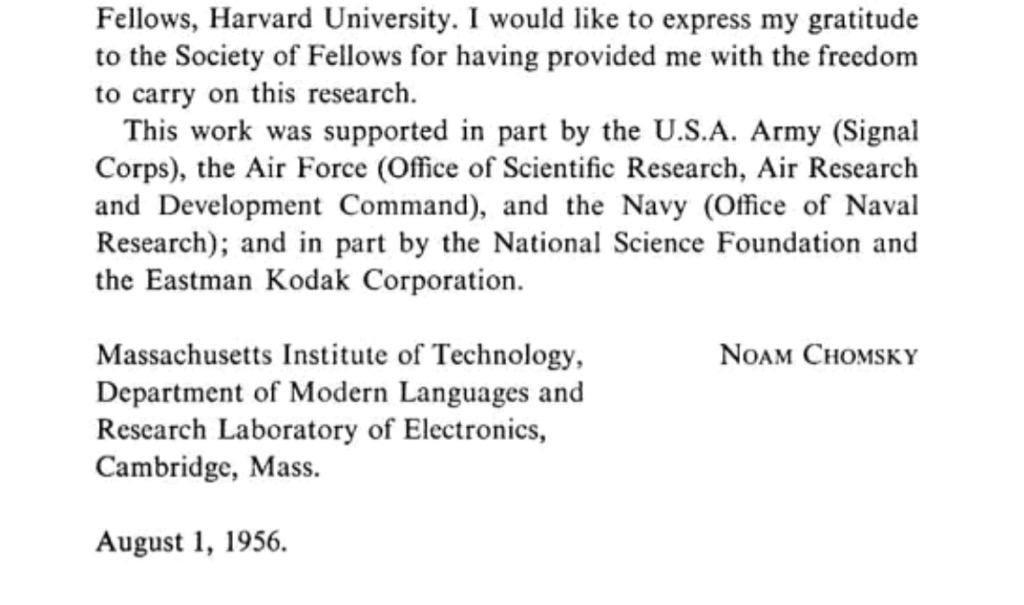
His revolutionary 1957 work, Syntactic Structures, which alienated social scientists by abstracting language from history and society, proved highly attractive to the U.S. military establishment. The emerging field of command-and-control computing saw in generative grammar the promise of a formal model of language that could be implemented computationally—a bridge between human orders and machine execution. As the preface to the first edition coldly acknowledges, the research was funded in part by the U.S. Army, Air Force, Navy, the National Science Foundation, and the Eastman Kodak Corporation
The military’s interest was not academic. Colonel Edmund P. Gaines of the Air Force articulated a blunt rationale:
“The Air Force has an increasingly large investment in so called ‘command and control’ computer systems… Command and control systems would be easier to use, and it would be easier to train people to use them, if [the] translation [from English] were not necessary. We sponsored linguistic research in order to learn how to build command and control systems that could understand English queries directly.”1
The appeal was precisely in Chomsky’s decontextualized, rule-based model of language. By defining language as a formal system of symbols separable from meaning, use, and social reality, Syntactic Structures offered a blueprint for the military’s “holy grail”: a computational system to understand and, by implication, more efficiently execute commands for operations like the defense of the continental United States or, as Gaines noted, “our forces in Vietnam.”
When asked about the nature of his work and US department of defense funding in 1971, contorted his logic by invoking Karl Marx:
Now as to how I tolerate MIT, that raises another question. There are no people who argue, and I have never understood the logic of this, that a radical ought to dissociate himself from oppressive institutions. The logic of that argument is that Karl Marx shouldn’t have studied in the British Museum which, if anything, was the symbol of the most vicious imperialism in the world, the place where all the treasures an empire had gathered from the rape of the colonies, were brought together. But I think Karl Marx was quite right in studying in the British Museum. He was right in using the resources and in fact the liberal values of the civilisation that he was trying to overcome, against it. And I think the same applies in this case.
Of course, there is a huge difference between using a reading room of a public building and being a tenured faculty at an institute that directly did military research such as developing more advanced weapons systems to further US military aims.
Chomsky defending the DOD funding in a 2016 interview, he stated,
‘That’s actually a widespread illusion. … It’s very widely believed but basically the military didn’t care what you were doing. In our our project at MIT for example, one of the main works were on American Indian language. The military didn’t care. What the military was doing was serving a kind of a funnel by which tax-payer money was being used to create the hi-tech economy of the future
But even this example is misleading. American Indian languages did have military applications—the Navajo code-talkers being the most famous example. More importantly, his theory promised a universal translator for military communications, even though it ultimately proved useless for computational linguistics. The pattern reveals something larger about Chomsky: a willingness to minimize his own proximity to power.
But one cannot wonder the very important question: During the cold war, academics, even in hard sciences were purged for having any marginally leftist views, he was kept on, not only tolerated but celebrated.
There are other instances when Chomsky defended figures at the heart of U.S. empire. Walt Rostow—an economist who wrote The Stages of Economic Development: A Non-Communist Manifesto, calling communism a “disease of transition” requiring U.S. military intervention to resist—served as Johnson’s national security advisor from 1966, continuously advocating for more hawkish, cruel, and extensive engagement by the U.S. military in Vietnam.
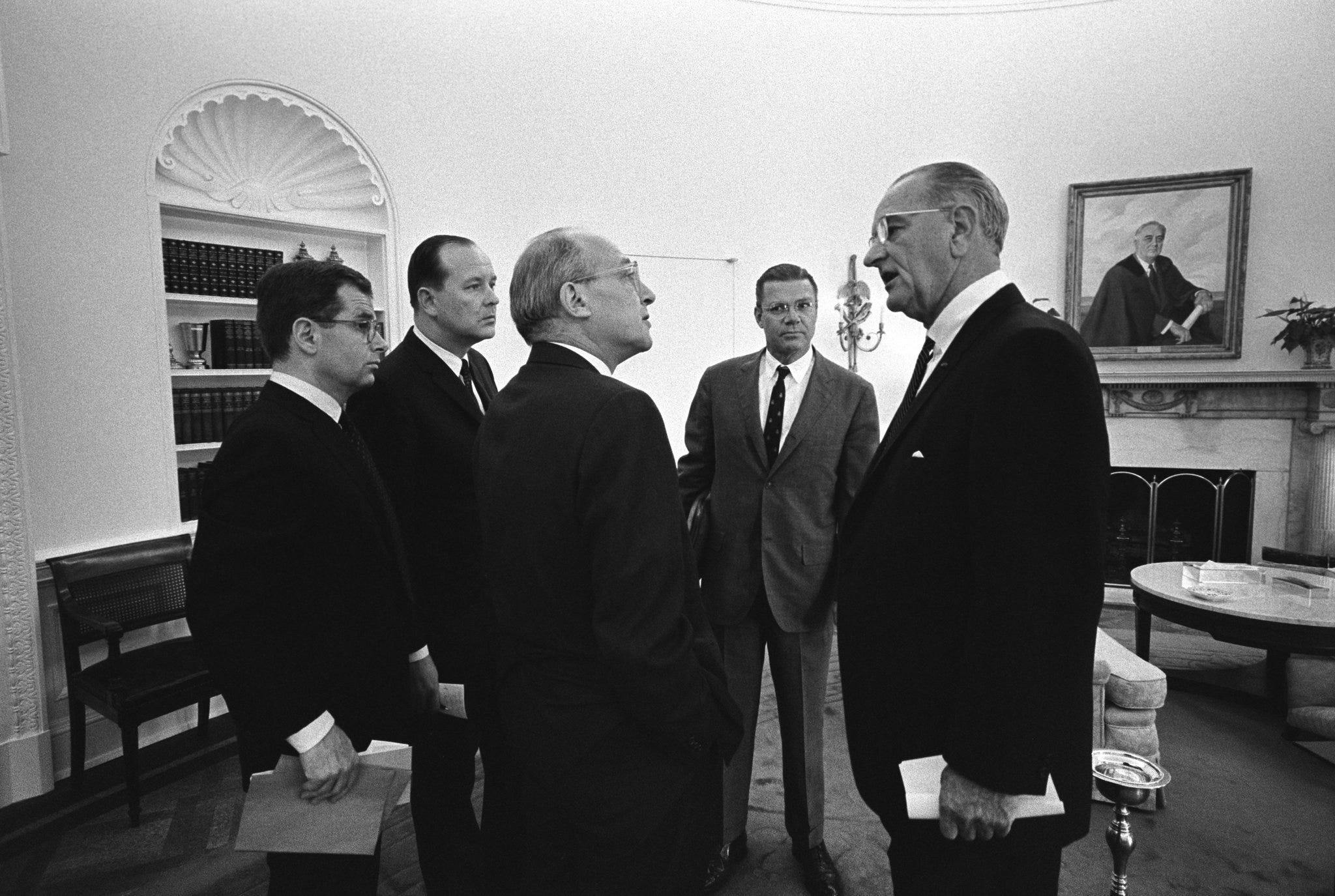
When Richard Nixon won the Presidency, Rostow was no longer needed, and MIT initially contemplated offering Rostow his old job back. Student protests made them reluctant. Yet Chomsky’s position was
In fact, as a spokesman for the Rosa Luxemburg collective, I went to see the President of MIT in 1969 to inform him that we intended to protest publicly if there turned out to be any truth to the rumors then circulating that Walt Rostow (who we regarded as a war criminal) was being denied a position at MIT on political group.2
While protests against Rostow led MIT to decide not to offer him a position, this was not the only powerful person with reprehensible politics that Chomsky supported. There is the story of John Deutch, who headed two Pentagon panels on Intercontinental ballistic missiles alongside figures like Henry Kissinger and Donald Rumsfeld. While serving in the Reagan administration, John Deutch advised MIT to apply for an army contract for mycotoxin research—in other words, biological weapons. In 1988, he was offered a position as Provost at MIT, which was met with outrage among students and faculty3. But Chomsky recounted in his 1996 book:
We were actually friends and got along fine, although we disagreed on about as many things as two human beings can disagree about. I liked him. We got along very well together. He’s very honest, very direct. You know where you stand with him. We talked to each other. When we had disagreements, they were open, sharp, clear, honestly dealt with. I found it fine. I had no problem with him. I was one of the very few people on the faculty, I’m told, who was supporting his candidacy for the President of MIT.4
Later in 1995, when the Clinton administration wanted to appoint Deutch as the head of the CIA, he was met with Chomsky’s endorsement:
[Deutch] has more honesty and integrity than anyone I’ve ever met in academic life, or any other life. If somebody’s got to be running the CIA, I’m glad it’s him.
Apparently, integrity means supporting research into biological weapons in Noam Chomsky’s world. These friendships put his letter of recommendation for Epstein into perspective. It is not an error in judgment. It is the latest installment in a long-standing practice of maintaining cordial relations with figures at the heart of U.S. military and intelligence power, while maintaining the public image of being a “dissident” critic of US foreign policy.
As his linguistic theories proved useless for any actual linguistic applications, perhaps Chomsky’s value lies in his position as the “acceptable dissident”—one who echoes Rostow’s anticommunist position while misinforming a vast number of people about U.S. enemy states. Applying the propaganda model to Chomsky himself, he functions as a gatekeeper who leads well-intentioned activists into ineffective tactics and analysis that pose no threat to American power.
Part 3: Chomsky: The Moderate Rebel
Frederick J. Newmeyer, The Politics of Linguistics (Chicago: University of Chicago Press, 1986), 84
Robert F. Barsky, Noam Chomsky: A Life of Dissent (Cambridge, MA: MIT Press, 1997), 140-141.
Thomas T. Huang, “Examining John Deutch’s Pentagon connections,” The Tech (MIT), Vol. 108, No. 26, May 27, 1988, 2.
Noam Chomsky, Class Warfare: Interviews with David Barsamian (London: Pluto Press, 1999), 135-136.
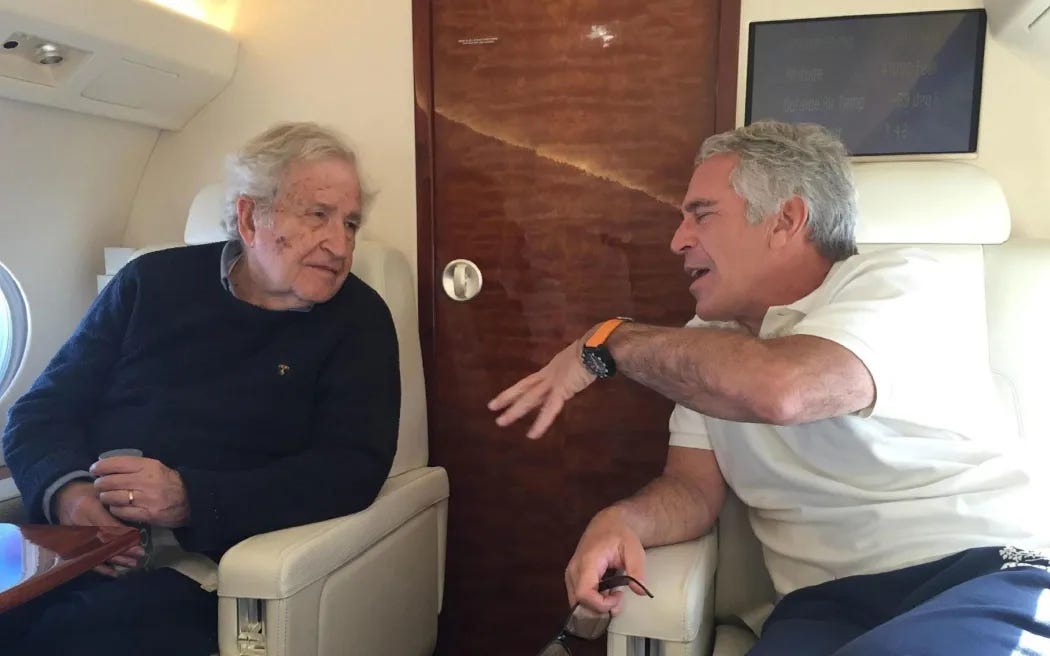
The image of Chomsky alongside Jeffrey Epstein is revealing, not incidental. It captures a career defined by proximity to power without consequence. Unlike genuine anti-imperialists who collided with the state—the Black Panthers, Weather Underground, or figures such as Hugo Chávez, Fidel Castro, Che Guevara, Philip Agee, or Patrice Lumumba—Chomsky was never arrested, disappeared, exiled, or neutralized. That absence is not a mystery; it is the point. Empire does not protect its enemies. It protects those who help manage dissent. Chomsky represents a class of elite intellectuals whose weapon is not resistance but confusion—dense diction, endless qualification, and moral posturing that drain urgency while never threatening power.
Chomsky’s entire career is built on talk without rupture: books, lectures, prestige, and safe critique converted into personal capital. His “lesser-evil” voting doctrine permanently disciplines voters into a genocidal duopoly; his opposition to BDS undercut one of the few effective non-violent tools for holding Israel accountable; his rigid two-state orthodoxy obstructed a single democratic state with equal rights; his positions on Syria aligned conveniently with U.S. and Israeli objectives; and his minimization of the JFK assassination foreclosed serious inquiry into power blocs—including pro-Israeli nuclear tensions—despite Kennedy’s pressure on Israel over nuclear weapons. On 9/11, Chomsky reduced the event to “blowback,” a framing that prematurely closed inquiry, dismissing or discouraging deeper investigation raised by others into anomalous collapses, thermitic materials, controlled demolition, or advanced weapons claims, while maintaining near-total silence on contemporaneous reports of Israeli nationals detained and later released amid pre-attack intelligence irregularities. Again, his role was not to interrogate power but to define the boundaries of acceptable questioning.
The pattern is unmistakable: acknowledge just enough to appear critical, then enforce narrative closure where accountability would begin. Chomsky does not threaten empire—he stabilizes it. He converts outrage into language, resistance into seminars, and dissent into intellectual theater. That is why he is celebrated, protected, and endlessly platformed. Empires do not reward those who endanger them; they reward those who contain opposition. This is not radicalism—it is intellectual management of dissent, dressed up as critique.
A couple of really interesting articles. Thanks, Esha. More than 30 years ago now, I used NC's Propaganda Model as the theoretical basis for my PhD research into British mass media coverage of a couple of late colonial wars in the 1950s.
I'm a lifelong anarchist communist, more inclined to call myself a libertarian communist these days I suppose. NC's work and connections clearly need to be vigorously investigated. I'm looking forward to reading part 3.